Appearance
Legal research
Ask a legal question in plain language. You get a reasoned answer built from the authorities, with the cases and statutes it relied on listed underneath, each one a click from the source.
What it searches
Every answer is written from documents retrieved for your particular question: Kenyan case law from every court, all Acts in force together with the Constitution, and the determinations of the Office of the Data Protection Commissioner.
That retrieval is why the citations hold up. The answer is not a model recalling what it once read. Each authority it names is a document it actually pulled, which is why it will tell you when what you asked for does not exist rather than inventing something that fits.
Brief it on the facts that change the answer
General questions get general answers. Ask what the law is on setting aside an ex parte judgment and you get the familiar principles — the discretion, the merits, the need to move promptly. All correct, and none of it decides your matter.
A well-briefed research question tells it:
- The court and the jurisdiction — the High Court at Milimani, the Environment and Land Court, the Court of Appeal.
- Which side you are on. The same question researched for the applicant and for the respondent produces a differently weighted answer.
- The facts that bear on the issue — dates, sequence, what was done and what was not.
- What form you want the answer in — the authorities from a particular court, a comparison of two lines of cases, a structure you can lift into submissions.
Providing context goes further on briefing, including working from documents you attach. Prompting principles covers the general shape of a good instruction.
A worked example
The question, run on the live app:
I act for the defendant in a High Court civil suit at Milimani. Judgment was entered ex parte in 2023 after service was effected by substituted service — an advertisement in a daily newspaper — following leave granted on an affidavit that gave an address my client had vacated four years earlier. My client learnt of the judgment only when a warrant of attachment was executed 14 months after judgment. What is the threshold for setting aside an ex parte judgment where the leave for substituted service was obtained on a defective affidavit, and does delay in applying defeat the application where the defect goes to service itself? Give me Court of Appeal authorities.
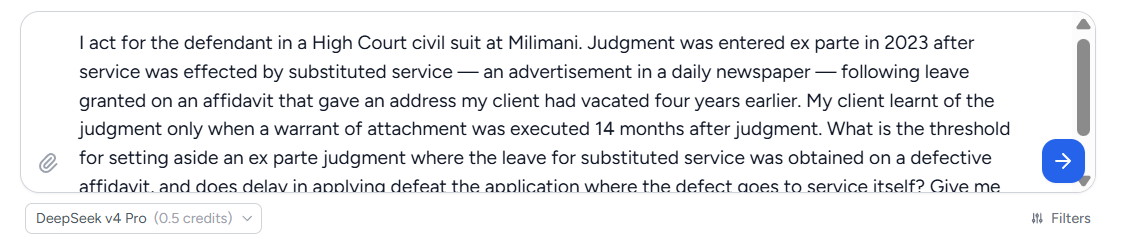
Four sentences: the court and station, which side, the sequence of events, then the two questions and the court whose authorities are wanted. Two facts carry the matter — the affidavit grounding the substituted service gave a stale address, and the client learnt of the judgment only on execution.
Watch what it does with the facts
While it runs, the progress log narrates the work.
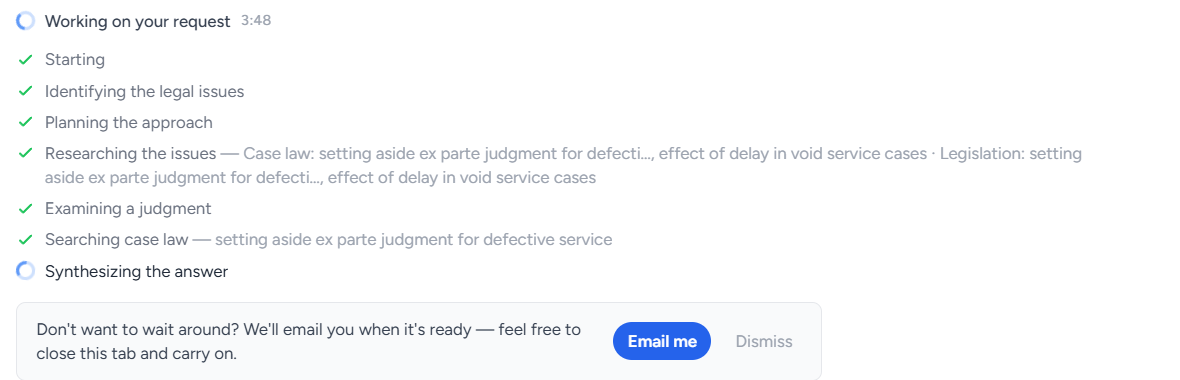
Researching the issues names what it went looking for: setting aside ex parte judgment for defective service, and the effect of delay in void service cases. It did not research the general discretion to set aside. It read the facts, saw that they raised a question about whether service was good at all, and researched that instead. Specificity does not only sharpen the answer — it changes what gets researched.
The Email me banner lets you close the tab. The work carries on without you and the result is emailed when it is ready.
The answer
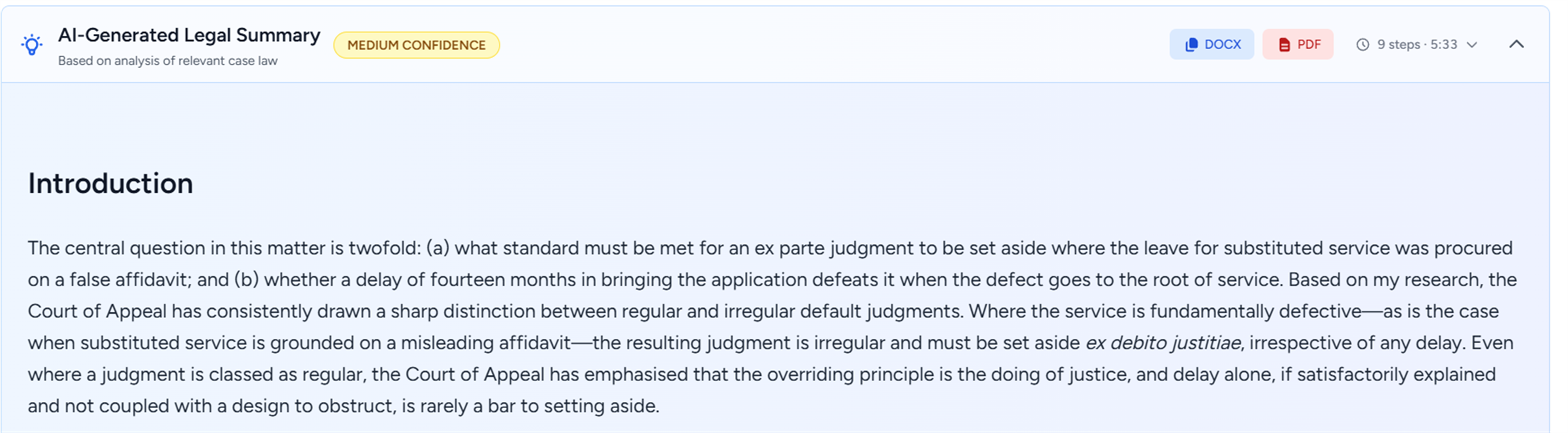
It separates the two questions and states its position: the Court of Appeal distinguishes regular from irregular default judgments, and where service is fundamentally defective the judgment is irregular and set aside ex debito justitiae, irrespective of delay.
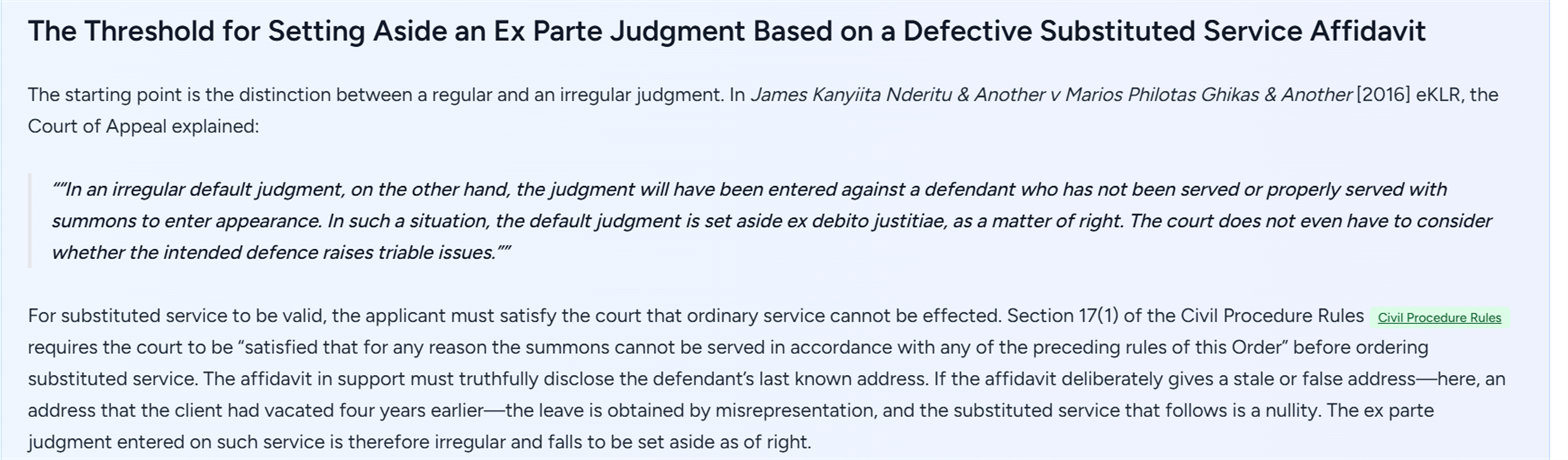
It quotes the authority rather than paraphrasing it, so you can see the words the argument rests on. And it reasons from your facts to the rule: the stale address makes the leave improper, the improper leave makes the service a nullity, the nullity makes the judgment irregular.
It also flagged a joint in its own argument. Of one authority it noted that the case dealt with failure to serve a hearing notice rather than substituted service, and explained why the reasoning still applied. That is where to look hardest.
This run came back MEDIUM CONFIDENCE. The badge is the assistant's own view of how well it handled the task, not a score, and the same question can be rated differently on another run. Read a medium rating as a prompt to check the authorities.
What comes with the answer
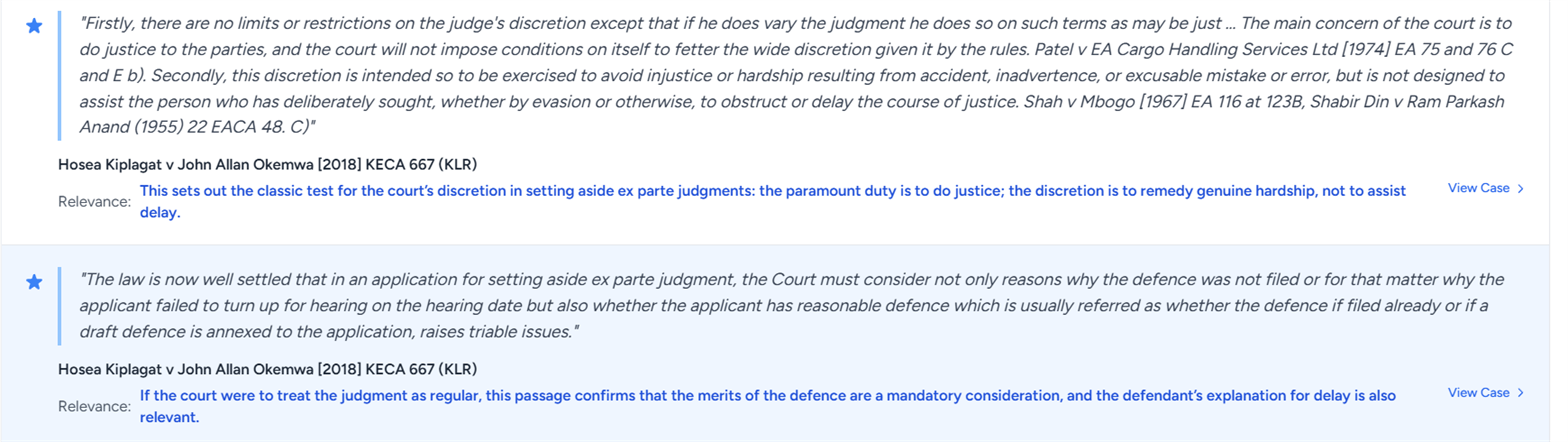
Key Case Law Quotations gives you the passages themselves, each with the case it came from, a note on why it matters, and a link to the judgment.
Key Act Quotations does the same for legislation — here the provision governing when a court may order substituted service, with a View Act PDF link.

Top Recommended Cases lists the authorities themselves — court, case number, date, and the authority-strength badge — with View, Download, Save, Tags, and View in Kenya Law.

View in Kenya Law puts the official copy one click away. Check every authority before you rely on it — Citations covers this in full.
Below the ranked list, More Case Laws holds everything else the run turned up, in this case another twenty-six judgments. Worth opening when you are building an argument rather than answering a question.
Export the whole answer to DOCX or PDF from the header.
Following up beats starting again
The conversation keeps its context, so you do not need to re-brief it to go deeper. Ask which of the authorities is weakest for your position. Ask for the contrary argument. Ask it to narrow to one issue, or to put the answer in a form you can lift into submissions. Ask what you have missed.
The progress log shows it carrying the previous authorities into the new run.
Limits worth knowing
- It produces work product, not advice. A qualified person reviews it and takes responsibility for it.
- Check the provision, not just the case. It does not fabricate citations, and it will say when it cannot find what you asked for. But a passage can be quoted accurately and still be labelled loosely, so confirm that a provision is the one you think it is.
- Confirm a case is still good law before it goes into a filing.
- The confidence badge is an opinion and varies between runs. Medium does not mean weak; high does not excuse you from checking.
- A thin answer usually means a thin brief. Before concluding the law is not there, check whether the question named the court, the side, and the facts that matter.
See Limitations for the fuller account.