Appearance
Document review & analysis
Attach a document and JuriBase AI will read it and answer questions about it — what it says, what it fails to say, and how it measures up against the law that governs it.
This is the capability that puts your own papers in front of it. Everything else on this site works from the public record; this works from the contract, the affidavit, the bundle or the pleadings in your matter.
Attaching a document
The paperclip sits at the left of the question box on the research screen. The Upload & Analyze card on the blank slate opens the same thing.
- PDF and DOCX are accepted.
- Up to five documents on a single question, so you can hand it a small bundle rather than one file at a time.
- Up to 64 MB each.
Attach the document and type the question in the same message; the two travel together. Attached documents are context only within the chat you attached them to — they are not drawn on in your other conversations. Everything you have uploaded is listed under My Documents in the sidebar.
Ask it something a reviewer would be asked
"Summarise this" is the weakest thing you can ask, and it is what most people try first. The capability is far stronger when you give it a standard to measure the document against and a side to argue from.
A good review brief says:
- Which document it is, and what it was for.
- Which side you act for, and what you are trying to do with it.
- The standard to measure against — the statutory requirements, the elements of the cause, the clause you are worried about.
- What you want back — the gaps, the risks, the strongest points, in whatever order is useful. Ask for gaps explicitly; it looks harder when you do.
A worked example
The matter running through Legal research and Drafting turns on an affidavit that has so far only been described. Here it is.
📄 Download the affidavit used in this example (PDF) — a synthetic document with fictional parties, prepared for this page. Worth opening alongside, so you can judge the review against the source yourself.
The brief:
I act for the defendant in the High Court at Milimani, Civil Suit No. 245 of 2022. Attached is the affidavit the plaintiff swore in support of its application for leave to effect substituted service, on which the leave of 12 December 2022 was granted. My client vacated the address given in it in 2018.
Review it against what an applicant must establish before a court will order substituted service. Tell me what it fails to depose, where it is merely formulaic, and which of those gaps are strong enough to found an argument that the leave was improperly obtained. Quote the paragraphs you rely on, and give me Court of Appeal authority.
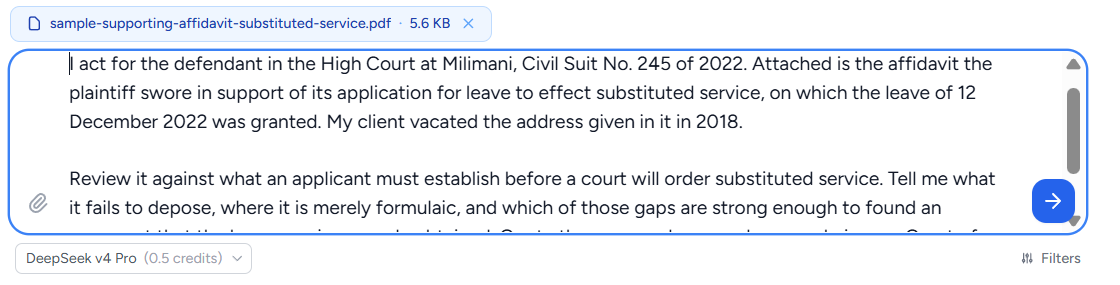
Not "what does this affidavit say", but: measure it against a legal standard, tell me where it is thin, and rank what I can use.
Reading the document
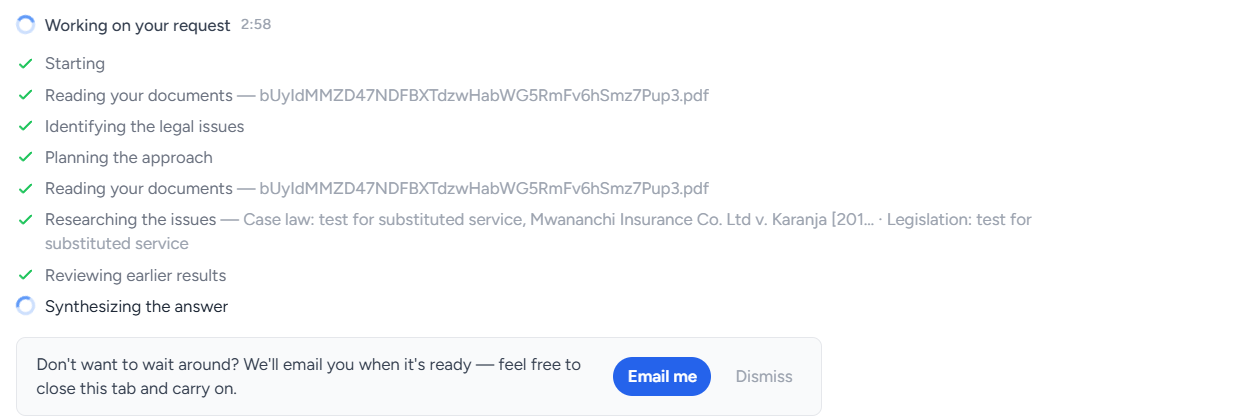
Reading your documents appears more than once. It returns to the document after it has researched, rather than reading once and working from a summary. The filename shown is the stored one, not the name on your machine.
Alongside it are the usual research phases. It is not only reading your affidavit; it is going and finding the standard to judge it by.
What came back

It opened by establishing the benchmark — Order 5, rule 17 of the Civil Procedure Rules, and the seven-point test from Ranchhodbhai J Patel v Arusha Cycle Mart, adopted by the Court of Appeal in Khaminwa v Spiga & 6 others [2023] KECA 678 (KLR): that the summons issued, that efforts to serve personally are set out with great particularity, that all practical means are exhausted, that prompt personal service is impossible, that the proposed mode will probably come to the defendant's knowledge, and that any belief in evasion is supported by the facts founding it.
Then it took the affidavit through that test, limb by limb.
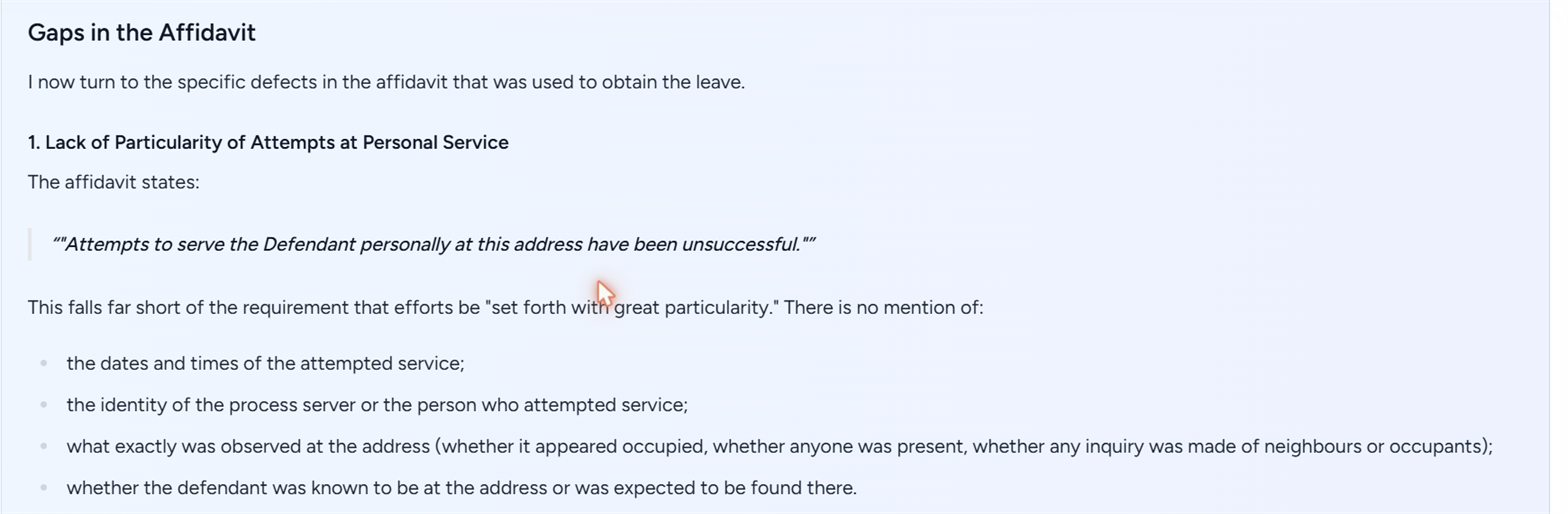
It reports what the document does not say, which is the hardest thing a reviewer does. Anyone can summarise the paragraphs that exist.
It found the same for the rest — no particulars of what tracing efforts were made, no averment that prompt personal service was impossible, no explanation of why a newspaper advertisement would be likely to reach this defendant, and an assertion of evasion with no facts behind it. It also suggested a Companies Registry search as an obvious step that was never deposed.
Finally it ranked what was usable:
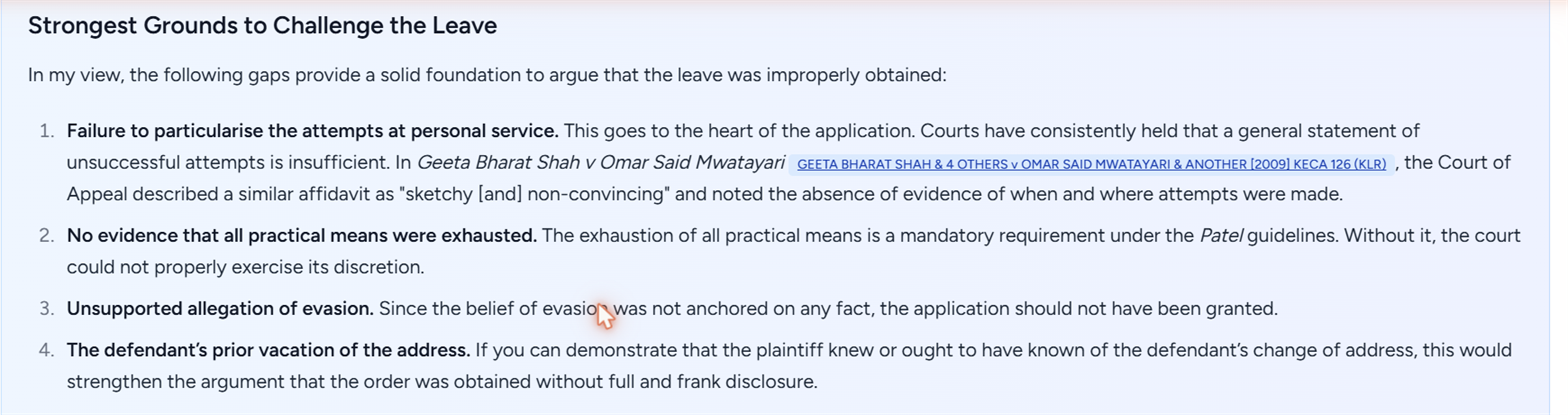
The ranking tells you which of the defects will carry weight, not just which exist.
It comes with its authorities
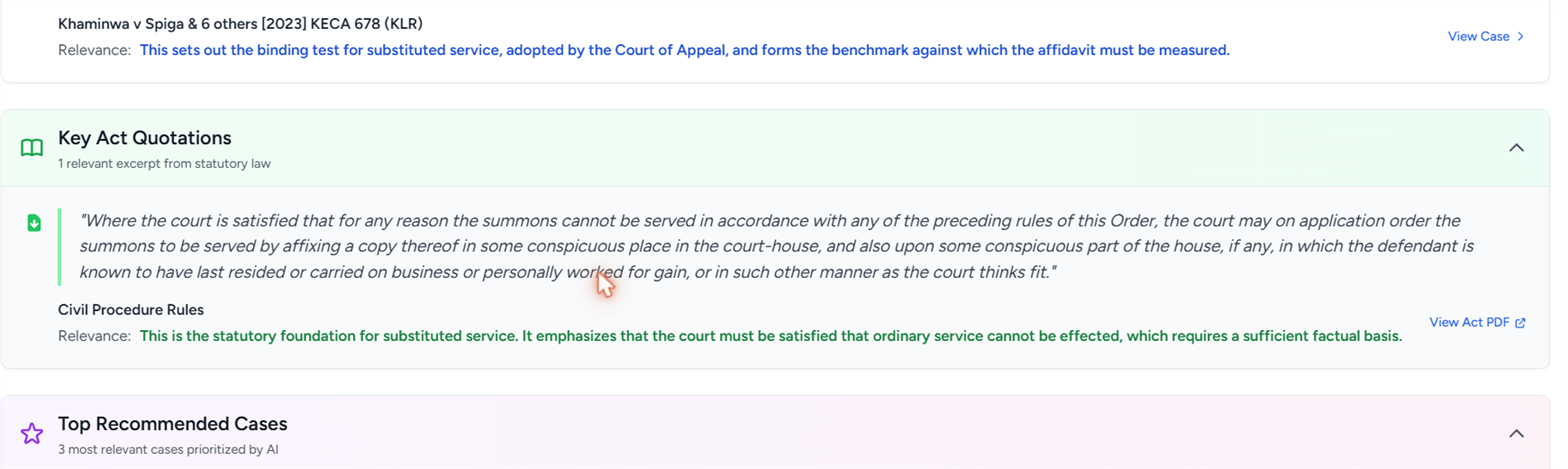
A document review carries the same apparatus as a research answer — Key Case Law Quotations, Key Act Quotations, and Top Recommended Cases, each with View in Kenya Law or View Act PDF. The standard it measured your document against is itself checkable.
The document stays in context afterwards, so you can narrow, re-rank, or ask it to turn its findings into submissions without re-attaching.
Where it needs watching
The judgment in that review was sound. The fidelity to the document text was not. Document review is strongest at reasoning about a document and weakest at reproducing it.
It paraphrases inside quotation marks. Every passage it presented as a quotation from the affidavit was reworded. Mostly harmlessly — the affidavit's "attempts to serve the Defendant personally at the said address have been unsuccessful" came back as "at this address". One mattered. Paragraph 8 of the affidavit reads:
THAT I am advised by my client, which advice I verily believe to be true, that the Defendant is evading service of the summons herein.
The review rendered that as "The Defendant is believed to be evading service." In compressing it, it lost the fact that the allegation of evasion was hearsay from the client — a better objection than the one it went on to make. Never lift a quotation from a review into a submission without checking it against the document.
It gave no paragraph numbers, although the brief asked it to quote the paragraphs relied on. You still have to find each passage yourself, which is another reason to read with the document open.
It lost track of what the defendant was. XYZ Contractors Limited is a company, but the review repeatedly wrote about it as a person — "his known telephone number", "he changed his address". Service on a company engages its registered office, so a reviewer holding that fact firmly would have pressed the point harder.
Limits worth knowing
- It flags; you decide. A gap it identifies may be curable, immaterial, or already answered elsewhere in the record it has not seen.
- It only knows what you attached. It cannot see the rest of the file, and it will reason confidently from a partial picture. The review above had no idea whether a process server's affidavit was annexed to the application, because it was never given the application.
- Scanned documents depend on the text being extractable. A photographed or image-only PDF may yield little.
- The confidence badge is an opinion. This review came back HIGH CONFIDENCE and still carried the defects described above.
See Limitations for the fuller account.