Appearance
Drafting
Give JuriBase AI a brief and it comes back with a first draft — submissions, a pleading, an application, a letter, or a single clause.
It researches the point before the writing starts, drafts to the structure you asked for, and lists the authorities it relied on underneath, each one a click from the source. That makes the review job checking real citations rather than hunting for invented ones.
What it drafts
Written submissions, statements of defence and other pleadings, applications and supporting affidavits, demand and advice letters, legal opinions, and individual clauses. If you sit on the bench, it also drafts rulings and judgments — see below.
Brief it like you would a pupil
A research question wants the legal issue. A drafting brief wants that and everything the document itself needs on its face:
- The forum and the cause — the court, the station, the division, the suit number.
- The parties, and which one you act for.
- The relief sought — precisely what you want the court to order, including consequential orders.
- The facts you are prepared to plead, with dates and sequence. Not the whole file: what the document has to assert.
- The structure you want, in the order you want it.
- The length and the register — "under four pages, in the register of Kenyan High Court submissions" does real work.
Say what to leave out, too. If a limb is weak and you do not want it argued, say so; otherwise it will be argued.
A worked example
The matter from Legal research — the ex parte judgment entered after substituted service was obtained on a stale address — turned into a drafting brief:
I act for the defendant in the High Court at Milimani, Civil Suit No. 245 of 2022 (ABC Supplies Limited v XYZ Contractors Limited). Draft written submissions in support of our Notice of Motion to set aside the ex parte judgment entered on 14 March 2023, all consequential orders, and the warrant of attachment issued on 2 May 2024.
The facts: service was by substituted service — an advertisement in a daily newspaper on 9 January 2023 — following leave granted on 12 December 2022 on an affidavit that gave an address my client had vacated in 2018. My client learnt of the judgment only when the warrant was executed on 20 May 2024. Our defence denies the debt and pleads limitation.
Structure it as Introduction, Issues for Determination, Submissions on each issue, and Conclusion setting out the orders sought. Lead on the distinction between regular and irregular judgments and setting aside ex debito justitiae; deal with delay in the alternative. Rely on Court of Appeal authority. Keep it under four pages, in the register of Kenyan High Court submissions.
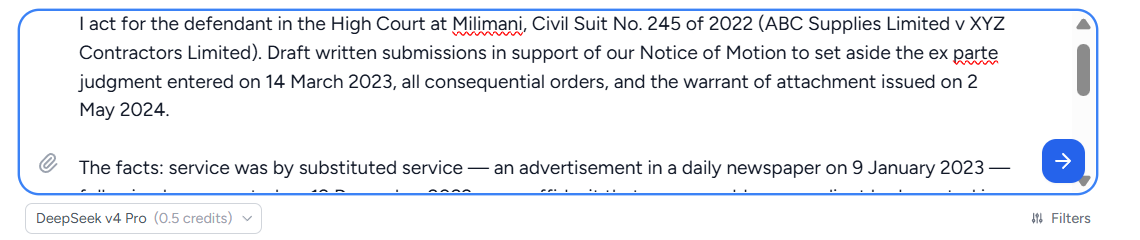
Every element of the checklist above is in there, and each one shows up in the draft.
It researches before it writes
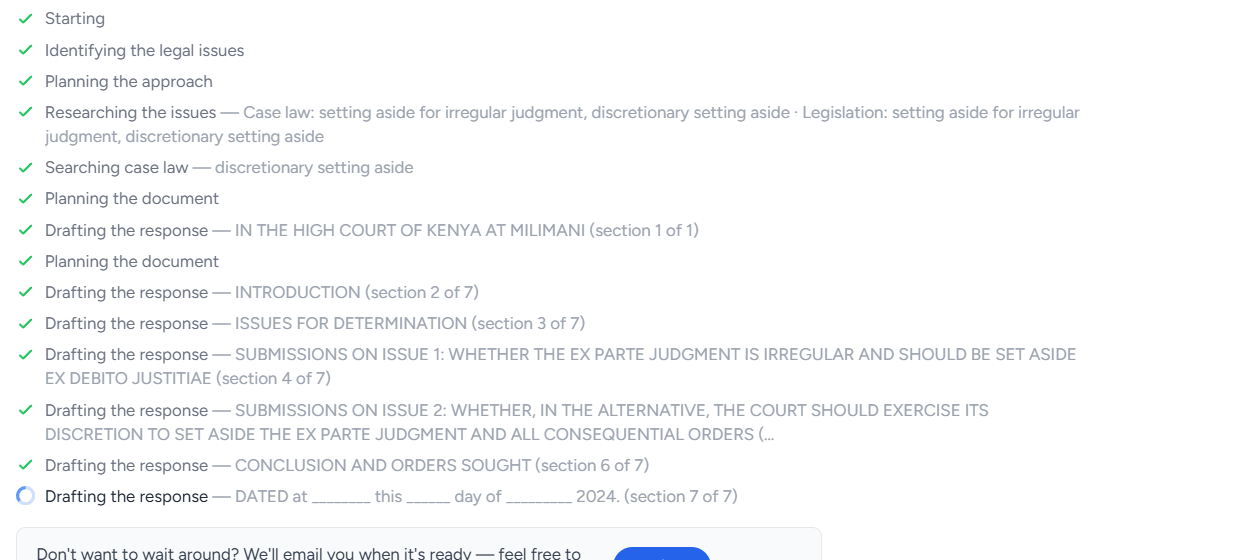
It runs the research phases first — Researching the issues, Searching case law — then Planning the document, then Drafting the response once per section. The sections are named as it writes them, in the order you asked for.
That is the check worth doing while it runs. If the section names coming past are not the document you wanted, stop and re-brief rather than waiting for four pages of the wrong thing.
The draft
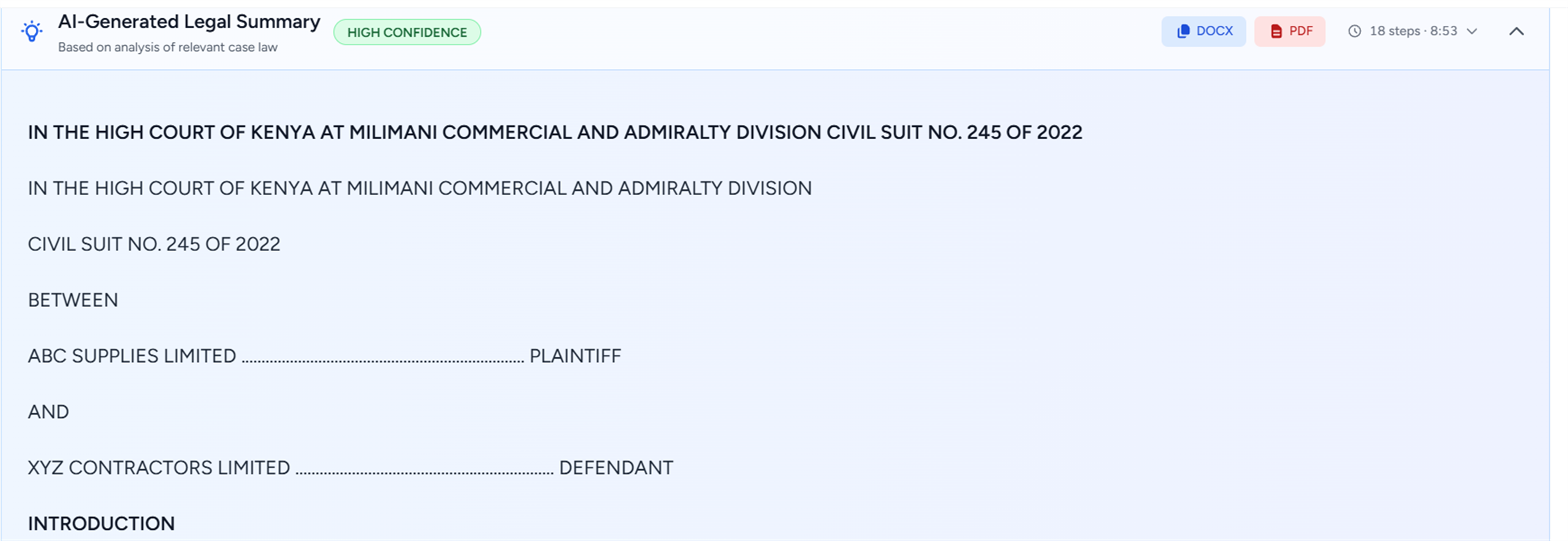
It opens as a court document opens — cause title, division, suit number, parties — not as a chat reply about a court document.
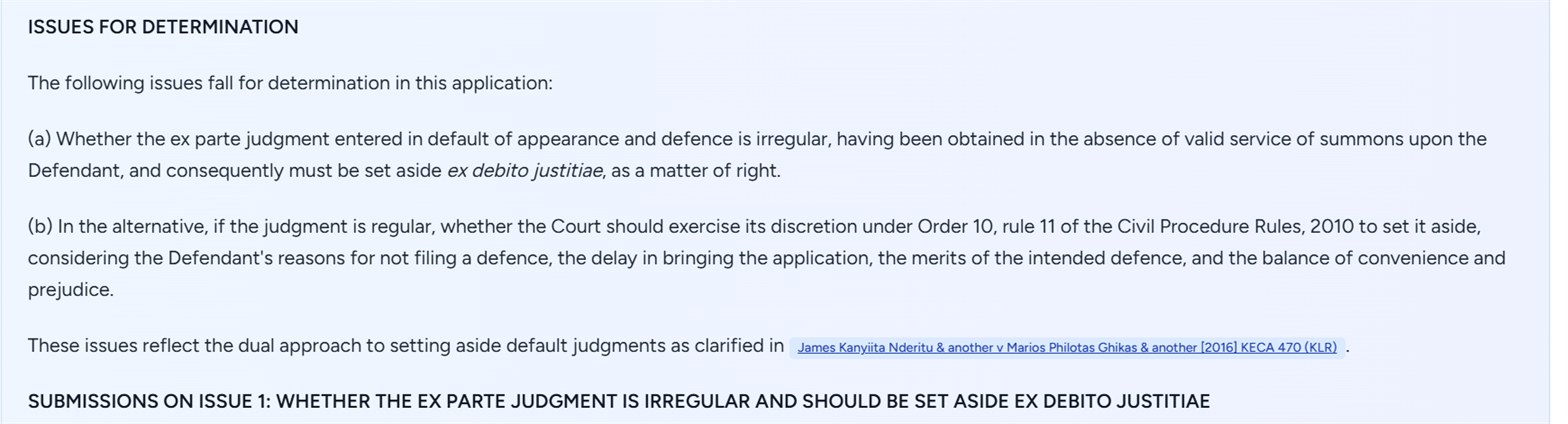
The issues are framed as the two-limb argument the brief asked for: irregular first, discretion in the alternative. The authorities appear as inline citation chips you can click straight through to the judgment.

It closes with the orders actually sought, as the brief asked.
The authorities come attached

Top Recommended Cases lists what the draft relied on — here twelve authorities, led by the Court of Appeal decision the argument is built on, carrying a Strong authority-strength badge. More Case Laws holds the rest the run turned up. Where a draft leans on particular passages you also get Key Case Law Quotations and Key Act Quotations; this run argued from principle rather than quotation, so it returned the case list alone.
Between the inline chips and that list, every authority in the document is one click from its source. A draft that cites twelve cases needs twelve checks.
Export the whole thing to DOCX or PDF from the header. For drafting, the DOCX is usually the point.
Refine it, do not restart
Follow-ups carry the draft with them.
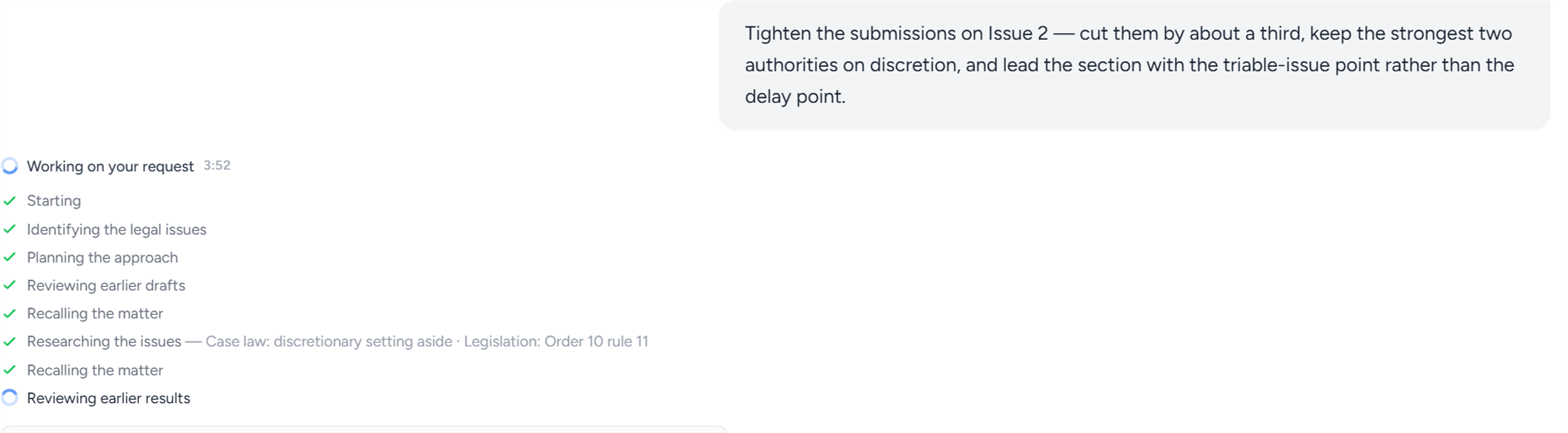
Reviewing earlier drafts and Recalling the matter in the log mean it is revising the document it already wrote, not producing a fresh one and hoping it matches.
Ask for what you would ask a junior for: cut a section by a third, lead with a different point, drop an authority, make paragraph 12 firmer, shorten the recitals, add a limb on limitation. Rewriting the original brief and running it again is almost always the worse move.
If you sit on the bench
Judicial officers use the same capability to draft rulings and judgments from the filed material, and the briefing differs.
Give it the parties and the application actually before you, the record it is to work from — the applications, affidavits and submissions filed — and the disposal you have reached. The register is neutral: findings rather than advocacy, reasons rather than persuasion. Ask it to set out the issues, the rival contentions, the analysis and the disposition, and say plainly which way you are deciding and why. A draft written without that will hedge.
Everything else on this page applies unchanged, and the review discipline applies with more force. Check every authority. Check that the reasoning is yours and that the draft has not smoothed over a finding you did not make.
Where your voice comes from
Two things shape how a draft reads, and neither belongs in the brief itself:
- Template training — upload drafts you have settled and it will mimic your house style in new ones.
- Custom instructions — standing preferences applied to everything you ask for, so you are not restating them each time.
Check before it leaves your desk
Two things this example did are easy to miss on a quick read.
It leaves placeholders — and does not always fill the ones it could. The draft left [date], [outdated address], [Defendant's Name] and blank advocate details for completion, which is right. But it filled the dates in the Conclusion while leaving [date] in the Introduction for the same event. Read the document through for consistency, not just for gaps.
It can add substance you did not give it. The brief said the defence denies the debt and pleads limitation. The draft went further and pleaded that the debt "arose from a transaction that is tainted with illegality and is unenforceable at law" — a plea never instructed and possibly untrue. Gaps get filled with plausible material, and plausible material in a pleading is something you will be held to. Read the draft against your brief and strike anything you did not ask for and cannot support.
Beyond those:
- Check every authority. The citations are retrieved rather than invented, but currency and continued good standing remain yours to verify — that is what View in Kenya Law is for. See Citations.
- Check the procedural shell yourself — the form, the correct provision, the time limits, the prayers. A draft can read perfectly and still be procedurally wrong in a way only you will catch.
- The confidence badge is an opinion. This draft came back HIGH CONFIDENCE; that is not a substitute for reading it.
See Limitations.